.webp)
Every pool owner in Plantation, Florida knows the sinking feeling. You add water to your pool, and a few days later the water level drops again. You probably have a leak, but where is it?
Pool leaks happen for all sorts of reasons. Age, ground movement, wear and tear, and even the Florida sun can break down seals and crack surfaces over time. The tricky part is that leaks can hide in places you would never think to look.
In this guide, we will walk through the most common pool leak locations, the common causes behind each one, and what you can do about them. If your pool is leaking and you are not sure where to start, this is for you. Finding a leak in your pool starts with knowing where to look.
Common Places Where Pool Leaks Happen
Not all leaks are the same. Some are easy to spot. Others hide behind the pool shell, under the deck, or deep in your plumbing system. Knowing the common places where leaks occur can help you diagnose your pool before calling a professional.
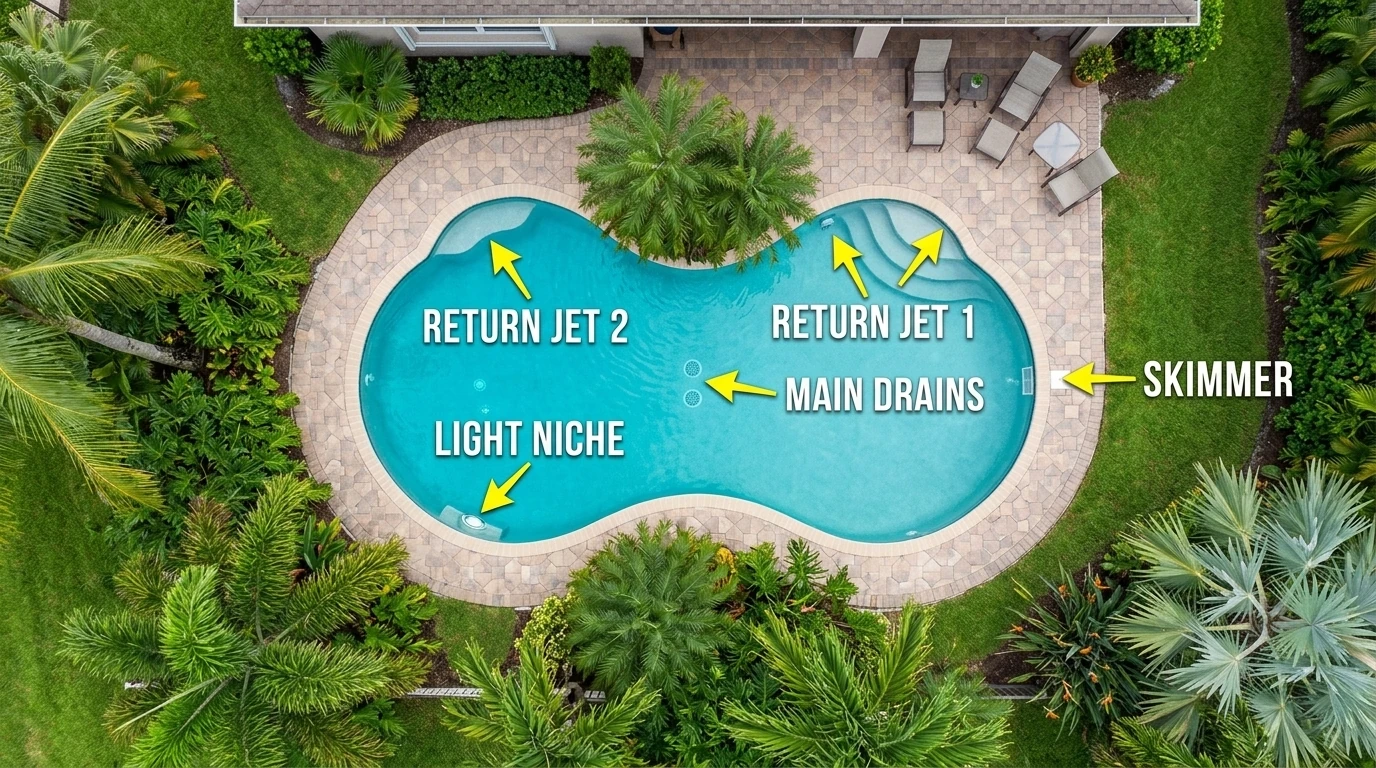
Here are the areas where most common pool leaks show up:
Let us break each one down so you know exactly what to look for.
Skimmer Leaks: The Number One Culprit
If you had to guess one spot where a leak starts, the skimmer is a safe bet. A skimmer leak is one of the most common issues we see in Plantation pools.
The skimmer sits where plastic meets the pool wall. Over time, the bond between these two materials weakens. In South Florida, the heat causes materials to expand and contract. That constant shifting creates gaps. When the joint where the skimmer meets the pool wall separates, water finds a way out.
Here are common signs of a leak in the skimmer:
- Water level drops to the bottom of the skimmer opening and then stops
- Cracks visible around the skimmer throat or near the skimmer mouth
- Air bubbles in the return jets when the pump is running
- Wet ground around the pool near the skimmer area
How to check: Turn off the pool pump and let the water settle. Apply dye near the skimmer opening and around the skimmer faceplate. If the dye pulls into a crack, you have found the point of the leak.
Pool skimmers take a beating in every type of pool. Whether you have a concrete pool, a fiberglass pool, or one with a pool liner, the skimmer is always a weak spot.
Pool Light Leaks: A Hidden Problem
Pool lights can leak in ways that are hard to notice. The light niche is set into the pool wall, and the conduit that runs from the light niche to the pool deck can crack or separate over time.
This type of leak is sneaky. You might not see wet spots or water loss right away. But over months, a pool light conduit leak can waste hundreds of gallons.
Common causes of pool light leaks include:
- A worn seal around the light housing
- A cracked conduit pipe behind the pool wall
- A failed gasket where the fixture sits in the niche
Pool lights can leak slowly, which makes them easy to overlook. If your pool water level keeps dropping and you have ruled out the skimmer, check around the light. A dye test near the fixture can help find a leak in this area.
Cracks in the Pool Shell: Structural Leak Warning Signs
Cracks in the pool shell are a clear red flag. While not every crack means there is a leak, many do. This is especially true in older concrete pools and fiberglass pools that have shifted due to ground movement.
In Plantation, the sandy soil and high water table can put extra stress on a pool shell. Over time, even a well-built pool settles. That settling leads to cracks. And cracks lead to leaks.
Here is what to watch for:
- Hairline cracks in the plaster or pool surface
- Larger cracks that run along the pool wall or floor
- Stains or discoloring near a crack (a sign water is moving through it)
A structural leak needs a pro. Common repair methods include pool putty for small fixes and Torque Lock staples for larger cracks. Some repairs may require draining the pool to access the damaged area. If you notice cracks in the pool shell, do not wait. What starts as a minor issue can grow fast.
Did You Know? A year old pool can develop cracks just from normal settling. It does not mean your pool was built wrong. It just means the ground around it shifted.
Underground Plumbing Leaks: The Ones You Cannot See
Some of the worst leaks are ones you will never see from the surface. Underground plumbing leaks happen in the pipes that run between your pool and your pool equipment. These pipes carry water to and from the pool pump, filter, and heater.
When a plumbing leak develops underground, the common signs include:
- Wet spots around the pool deck or in the yard
- Sinkholes or soft ground around the pool area
- A steady drop in pool water level that does not match evaporation
- Air in the plumbing system or pool pump losing prime
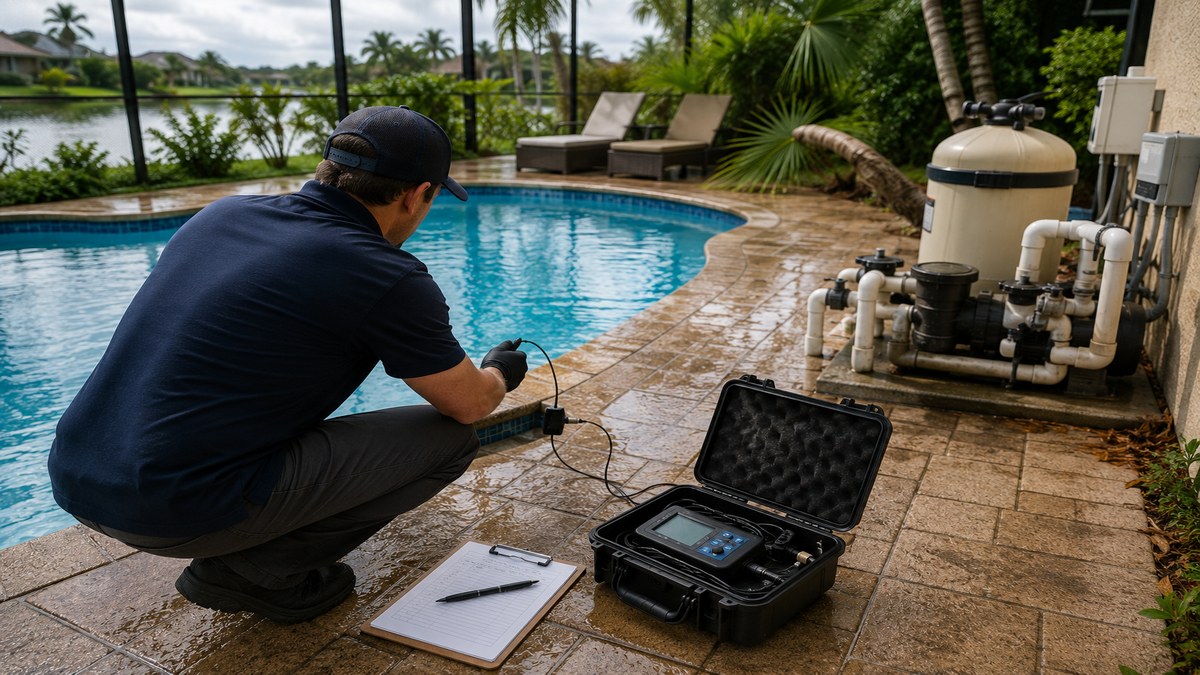
A pressure test is the best way to diagnose a leak in your plumbing. During a pressure test, each line is sealed and pressurized. If the pressure drops, there is a leak in that pipe.
Underground plumbing leaks are not DIY projects. They require professional leak detection equipment and experience to pinpoint the exact location. Without the right tools, you could end up digging in the wrong spot and making things worse.
Main Drain Leaks: Deep and Difficult
The main drain sits at the bottom of your pool. It is one of the hardest spots to inspect because it is always under water. A leak in the main drain area often goes unnoticed until water loss becomes obvious.
Common causes of main drain leaks:
- A cracked drain fitting or failed seal
- Pipe separation below the pool floor
- Soil shifting that pulls the drain pipe away from the pool shell
If your pool is leaking and you have checked the skimmer, lights, and returns with no luck, the main drain could be the culprit. A professional leak detection company can run a pressure test and a dye test on the main drain line to find the leak.
Pool Plumbing Connections and Equipment Leaks
Not every leak is in the pool itself. Sometimes leaks happen at the pool equipment pad. The connections between the pool pump, filter, and the filtration system can develop small drips that add up over time.
Common issues at the equipment pad include:
- Loose union fittings on the pump or filter
- Cracked PVC pipes from sun damage
- Worn O-rings or gaskets
- Valve failures
These leaks are often the easiest to spot. If you see water on the ground around your equipment, you have a good idea where to start. But even here, the fix matters. A bad connection today can lead to a flooded equipment pad tomorrow.
Pro Tip: Check the ground around your pool equipment at least once a month. Even a slow drip can waste a lot of water a day and drive up your water bill.
How to Tell If Your Pool Is Leaking or Just Losing Water to Evaporation
Before you panic, know this: every pool loses some water to evaporation. In Plantation, where temps stay high year-round, your pool water level will drop a bit each day. That is normal.
But how do you know if the water loss is from evaporation or a real leak?
The Bucket Test:
- Set a bucket on the pool step and fill it with pool water to match the pool water level.
- Mark the water line inside the bucket and on the pool wall.
- Turn off the pump and wait 24 hours.
- If the pool level dropped more than the bucket, you probably have a leak.
This simple leak test is the first step every pool owner should try. If the bucket test shows a leak, the next move is to call for professional leak detection.
Common Causes Behind Pool Leaks in Plantation, FL
Plantation pools deal with specific challenges. The local climate, soil type, and high water table all play a role. Here are the common causes that lead to leaks in this area:
- Heat and UV exposure - The Florida sun breaks down seals, gaskets, and plaster faster than in cooler climates.
- Soil shifting - Sandy soil moves over time, especially after heavy rain. This puts stress on the pool shell and underground plumbing.
- Age - Every part of a pool has a lifespan. Skimmers, lights, drains, and pipes all wear out.
- Poor past repairs - A quick fix that was not done right can fail and cause a bigger leak later.
- Ground movement from construction - New building nearby can shift the soil around your pool.
Understanding these common causes can help you stay ahead of problems. Regular checks and yearly inspections go a long way toward catching leaks early.
When to Call a Professional Leak Detection Company
Some leaks are easy to find with a dye test or a visual check. But many require advanced tools. If you have tried the bucket test, looked around the pool, and still cannot find the leak, it is time to call in the pros.
Here is when to reach out to Gator Leak Detection:
- The leak stops at a certain water level (this helps narrow down where it is)
- You see wet spots around the pool but cannot find the source
- The leak test confirms water loss but DIY checks come up empty
- You suspect a leak in your plumbing or underground lines
- Your pool is a leaking pool that keeps losing water after repairs
Gator Leak Detection uses pressure testing, electronic detection, and dye testing to find and fix every type of leak. We are a trusted leak detection company serving Plantation and all of Broward County.
Call Gator Leak Detection at (888) 645-5325
Protect Your Pool: How Gator Leak Detection Can Help
If your pool is leaking in Plantation, FL, do not wait for the problem to get worse. Whether it is a skimmer leak, a pool light conduit issue, cracks in the pool shell, or a leak in your plumbing, our team will find it and fix it.
Gator Leak Detection offers professional leak detection and repair for every common pool leak type. We use advanced tools to pinpoint the exact location, and we handle the pool repair on the spot so you deal with one crew and one visit.
Here is what we offer:
- Pool Leak Detection - Electronic, pressure, and dye testing to locate every leak
- Pool Repair - Skimmer, return, main drain, light niche, and plumbing fixes
- Structural Crack Repair - Torque Lock staples for lasting results
- Trenchless Pipe Repair - No digging, no demolition
- Swimming Pool Inspections - Full checkups to catch common issues early
Call Gator Leak Detection at (888) 645-5325 to schedule your leak detection and repair appointment. We serve Plantation, Fort Lauderdale, Cooper City, Weston, Coral Springs, Davie, and all of Broward County.