.webp)
You've noticed your pool losing water faster than South Florida's heat can explain. You've ruled out evaporation. Your water bill is creeping up. And someone mentioned that fixing the underground pipes might mean ripping out half your backyard.
That last part used to be true. It isn't anymore. Gator Leak Detection serves Fort Lauderdale and the surrounding Broward County area with trenchless pipe repair, a method that fixes underground pool plumbing from the inside out, no excavation, no destroyed landscaping, no weeks-long recovery.
Here's what trenchless repair actually involves, why it works so well in South Florida, and how to know if it's the right fix for your pool.
What Is Trenchless Pipe Repair?
Trenchless pipe repair fixes a damaged underground pipe without digging a trench along its entire length. Instead of excavating, a technician accesses the pipe through one or two small entry points and rehabilitates the pipe from the inside.
The most common method used for pools is epoxy pipe lining. A flexible liner coated with epoxy resin is inserted into the damaged pipe, inflated to press against the interior walls, and left to cure. Once hardened, you have a new pipe inside the old one.
The result is a structural repair that seals cracks, gaps, and deteriorated sections without disturbing the ground above.
Why Underground Pool Pipes Fail in Fort Lauderdale
Fort Lauderdale's environment is harder on underground plumbing than most homeowners realize. A few factors accelerate pipe damage here specifically.
Soil movement. Broward County's soil shifts with rain, drought cycles, and the water table rising and falling. That constant movement puts stress on rigid PVC pipes, especially at joints and elbows where the pipe changes direction.
Tree root intrusion. Fort Lauderdale's mature landscaping is one of its best features. However, roots from palms, ficus, and other common South Florida trees are aggressive. They find microscopic cracks in pipe joints and work their way in over time.
Age and material. A lot of pools in the Fort Lauderdale area were built in the 1980s and 1990s. Those pipes are now 30 to 40 years old, and PVC of that era wasn't built to last indefinitely. Corrosion, brittleness, and joint failure are all normal at that age.
Ground vibration. Heavy rainfall, nearby construction, and even consistent vehicle traffic on residential streets create low-level vibration that slowly stresses buried pipes over years.
None of these factors are unique to Fort Lauderdale, but they're all present here at the same time. That combination accelerates deterioration faster than in drier, more geologically stable climates.
Signs You May Have an Underground Pipe Leak
The tricky thing about underground leaks is that you can't see them. Because of that, homeowners often spend months assuming the water loss is evaporation before calling a professional.
These are the signs worth paying attention to:
- Your pool loses water consistently, not just on hot or windy days. Evaporation varies with weather. A leak doesn't.
- Soft or wet patches in the yard near the pool equipment or pool shell. Water migrating upward from a buried pipe will eventually saturate the soil above it.
- Unusually lush grass in one specific area. A slow leak creates a localized watering effect. If one patch of your yard is noticeably greener than the rest, that's worth investigating.
- Air bubbles returning through the jets. Air in the return lines can indicate a suction-side pipe breach where the pump is pulling air along with water.
- Pressure test results showing line loss. This is the definitive test. A technician pressurizes each pipe line and monitors for pressure drop. If a line loses pressure, there's a leak somewhere along it.
Not every pool water loss means an underground pipe leak. Skimmer cracks, light niches, fittings at the equipment pad, and shell cracks are all more common culprits. But when the equipment pad checks out and the shell looks solid, the underground lines are the next place to look.
How Gator Leak Detection Finds Underground Leaks
Before any repair, the leak has to be located precisely. This is where the process matters.
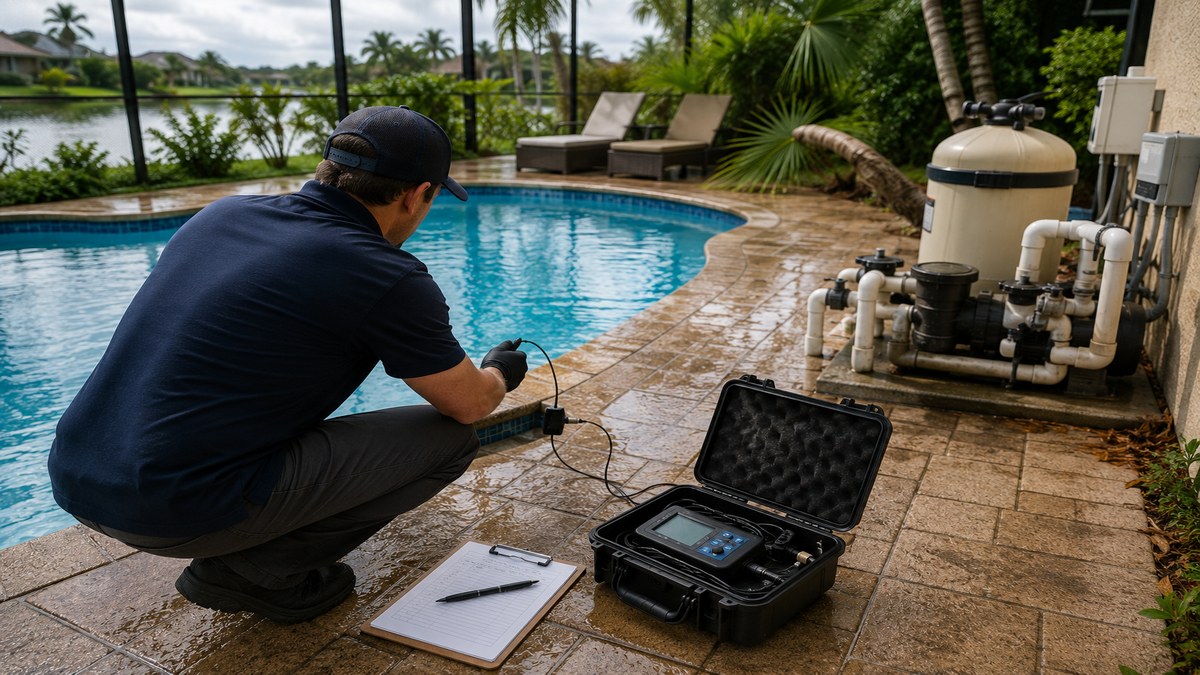
Gator Leak Detection uses acoustic listening equipment and pressure isolation testing to identify exactly which line is leaking and approximately where. Acoustic detection picks up the sound signature of water escaping under pressure, even through several inches of soil or concrete decking.
Pressure testing takes each plumbing line out of service individually and holds it under a known pressure. The technician watches for pressure decay. If a line drops pressure, it has a breach. If it holds, the line is intact. This approach narrows the problem down before any equipment is brought in for repair.
For most underground leaks in Fort Lauderdale pools, this diagnostic process takes a few hours. Homeowners get a clear answer: which line is leaking, where the problem section is located, and what repair method makes sense.
The Trenchless Repair Process: What to Expect
Once the leak is confirmed and located, the trenchless repair itself is straightforward.
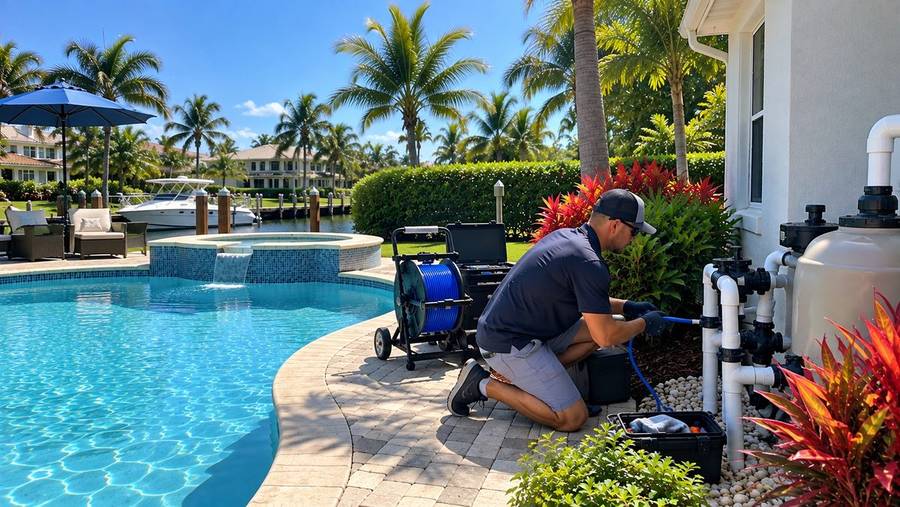
Step 1: Access point preparation. The technician identifies one or two small access points at either end of the pipe section being repaired. In most cases, this means opening a small area at the equipment pad or pool shell rather than anywhere along the pipe's path through the yard.
Step 2: Pipe cleaning. Before the liner goes in, the pipe interior is cleaned to remove debris, scale, and root material. A clean surface is essential for proper adhesion.
Step 3: Liner insertion and inflation. The epoxy-saturated liner is fed through the pipe and inflated with air or water pressure, pressing it firmly against the interior pipe wall. The liner conforms to the shape of the existing pipe, including curves and elbows.
Step 4: Curing. The epoxy cures in place, typically over several hours. Some methods use UV light to accelerate curing; others rely on ambient temperature and the epoxy chemistry.
Step 5: Reinstatement and pressure testing. Once cured, the liner is cut open at any lateral connections, the system is reassembled, and a final pressure test confirms the repair is holding.
Most trenchless pool pipe repairs in Fort Lauderdale are completed in a single day. Your yard looks the same when the crew leaves as it did when they arrived.
Trenchless vs. Traditional Pipe Replacement: A Real Comparison
The traditional alternative to trenchless repair is open-cut replacement. A contractor digs a trench along the pipe's path, replaces the damaged section, backfills, and recompacts the soil.
For a typical Fort Lauderdale pool, that process involves:
- Removing deck pavers, pool coping, or concrete decking if the pipe runs beneath them
- Digging through 18 to 36 inches of soil
- Disposing of excavated material
- Installing new pipe
- Backfilling and compacting in lifts
- Replacing any hardscape that was removed
The cost difference is significant, and the disruption is considerable. Landscaping removal and replacement alone often costs more than the pipe work itself in established Fort Lauderdale yards.
Trenchless repair doesn't eliminate excavation entirely in every situation. If a pipe has collapsed completely rather than cracked, a liner can't restore the original shape. In those cases, a short targeted excavation at the failure point may be necessary. However, for the majority of underground pool pipe leaks, which involve cracks, joint failures, and partial deterioration, trenchless is a viable and far less disruptive option.
FAQ
How long does a trenchless pipe repair last?
Epoxy pipe liners installed in residential pools are designed to last 50 years or more under normal conditions. The cured epoxy is resistant to the chemical environment inside pool plumbing, including chlorinated water and varying pH levels. In practical terms, a properly installed trenchless repair typically outlasts the original pipe it's installed inside.
Will trenchless pipe repair affect my pool's water flow?
The cured epoxy liner reduces the interior diameter of the pipe slightly, typically by a few millimeters. For most residential pool plumbing, this reduction has no measurable effect on flow rate or pump performance. A technician can confirm whether your specific pipe size and flow requirements would be affected before proceeding.
How do I know if my pool pipe leak is underground or at the equipment pad?
A pressure isolation test is the most reliable way to answer this. The technician isolates each plumbing line individually and tests it under pressure. Equipment pad leaks show up as visible moisture at fittings and unions around the pump, filter, and heater. Underground leaks produce pressure drop during testing without visible moisture at the surface. Gator Leak Detection uses both methods together to give you a definitive answer.
Does trenchless repair work on all types of pool pipes?
Epoxy lining works on PVC and CPVC, which are the materials used in the vast majority of South Florida residential pools. It also works on some older ABS pipe. The pipe must have a minimum intact diameter for the liner to be inserted and inflated properly. Very small pipes and pipes with complete structural collapse are not good candidates. A pre-repair inspection with a camera will confirm whether trenchless is viable for your specific situation.
Is my pool usable during the repair?
In most cases, the pool needs to be taken off circulation during the repair and for the curing period. That typically means one day of downtime. Because trenchless repair avoids the multi-day process of excavating, replacing, and backfilling, total downtime is significantly shorter than with traditional open-cut replacement.
How much does trenchless pool pipe repair cost in Fort Lauderdale?
The cost depends on the length of pipe being repaired, the number of access points required, and the liner material specified. Because every pool has a different plumbing layout, pricing is quoted after the diagnostic inspection. What homeowners consistently find is that trenchless repair costs less than open-cut replacement once landscaping removal, replacement, and permit costs for excavation work are factored in.
If your Fort Lauderdale pool is losing water and traditional diagnosis hasn't pinpointed the cause, an underground pipe leak is worth investigating. Gator Leak Detection uses non-invasive methods to confirm the problem before any repair work begins, so you're never paying to fix something that doesn't need fixing.
Book a consultation today and find out exactly what's happening with your pool.